House Swap Vacations: The Luxury Owner's Complete Guide
Discover how luxury house swaps work, from verified members and flexible exchanges to preparing your home with confidence.


A house swap vacation places you in a private, fully lived-in home on the other side of the world while a verified member stays in yours. For owners of exceptional homes, the questions are different: who gets vetted, how the property is prepared, and what a first exchange actually involves. This guide answers them, start to finish.
Key takeaways
- A house swap vacation is a stay in another member's home while they, or another member, stay in yours. Points-based systems mean the dates never have to align.
- Trust is structural, not personal. HomeExchange Collection verifies every member and every home, backs each stay with $3M damage protection, and staffs a 24/7 member line.
- The biggest planning advantage is flexibility: fix the destination or the dates, rarely both.
- Preparing a high-value home is a one-time system, not a recurring chore: secure a few private spaces, write one house manual, brief your housekeeper once.
- Most first swaps run one to two weeks. Seasoned members progress to a month or more.
What Is a House Swap Vacation and Home Exchange?
A house swap vacation is a stay in another person's home while they stay in yours, either at the same time or on different dates. Inside membership networks like HomeExchange, house swapping happens between verified members, and a points system allows non-reciprocal stays. No money changes hands for the accommodation itself. Some networks call it a home exchange vacation; the terms are interchangeable. For families who travel often, it offers access to real homes around the world without paying a nightly accommodation cost.
Two formats cover nearly every trip. In a reciprocal exchange, two families trade homes, simultaneously or months apart (you stay in their Provence farmhouse in June, they take your Aspen place over the holidays). In a GuestPoints stay, you host a member and earn credits, then spend those credits in any other member's home, no matching calendar required.
What separates an exchange from a rental is simple: these are real homes, not investment properties. The kitchen is a working gourmet kitchen because the owners cook in it. The bookshelves were assembled over decades, not styled for listing photos. And the exchange model keeps it that way. Homes stay lived-in rather than sitting empty between paying guests, which is why members often describe house swapping as the antidote to the ghost neighborhoods that short-term rentals leave behind. You do not pay a nightly rental rate, but you do invest time in choosing a suitable home, communicating expectations, and preparing your own.
Read also: How Luxury Home Exchange Works
Is House Swapping a Good Idea for a Luxury Homeowner?
For most owners of high-value homes, yes, provided the exchange happens inside a vetted network rather than an open marketplace. The concerns that matter most, member verification, property standards, guarantees, and community accountability, are precisely what a dedicated luxury tier exists to answer.
The hesitation is understandable. Your home holds art you chose, rooms your children grew up in, systems that took years to get right. Handing the keys to strangers is not appealing. The point of a verified community is that you never do. Every HomeExchange Collection member passes a verification process covering identity, ownership, and the home itself, which must meet the $2M+ standard. The person staying in your home owns a home like yours, keeps it to the standard you keep, and is accountable to the same community, with reviews and member stories visible to everyone.
There is also a quieter argument: reciprocity of care. A guest who is also a host treats your home the way they want theirs treated. That symmetry does not exist on any rental platform, and it changes how the entire trip feels, from the welcome note on the counter to the condition of the home you return to.
With 10,000+ verified luxury homes and members across 93 countries, the network is large enough that the constraint is rarely inventory. It is knowing how to plan.
How Do You Plan a House Swap Vacation, Start to Finish?

Plan a house swap vacation in stages: list and verify your home early, open conversations three to six months before travel, agree terms on the platform so the guarantees apply, prepare the home in the final two weeks, and hand off the keys through your housekeeper or another trusted contact.
Here is the timeline experienced members follow:
- Four to six months out: list and verify. Complete verification, then give the listing itself real care. Photograph the home the way you would for an architectural feature, wide, bright, honest. Strong photos are the best hour you will spend in the entire process, because inquiries flow to the listings that look cared for.
- Three to four months out: search and inquire. Decide your fixed variable (destination or dates), search with the filters that matter to you, and send thoughtful, personal inquiries to several well-matched homes. As a practical rule of thumb, expect to send roughly 10 requests to secure one yes.
- Two to three months out: agree the match. Trade messages, take a video call, walk each other through the homes, and confirm dates, guests, and expectations on the platform so the guarantees apply.
- Two weeks out: prepare the home. Secure private spaces, update or create your home guide with entry instructions and practical details such as how to operate the home's technology and where to find the laundry, brief your staff, and confirm arrival logistics.
- Swap week: the handoff. Keys pass through your housekeeper, estate manager, or a lockbox, with a welcome note and a stocked refrigerator doing more for the relationship than any formality.
- The return: close the loop. Review your exchange partners and reply to the inquiries your listing collected while you were away.
First exchanges take the most effort. By the second, your listing, manual, and staff routine already exist, and planning collapses into choosing where to go.
How Do You Choose Home Swap Destinations and Dates?
Fix one variable and stay flexible on the other. Members who name a destination but leave dates open, or lock dates but stay open on where, match faster and better than members who need Lake Como for the second week of August. Flexibility is the currency of every home exchange network. It also gives your family more ways to discover places beyond the usual hotel map, from a walkable city neighborhood to a quiet country or seaside village.
A few planning realities help:
- Non-simultaneous swaps widen everything. Your exchange partners can visit while you are at your city residence or traveling elsewhere, and you take their home months later. The calendar problem most people imagine rarely exists in practice.
- GuestPoints create more calendar flexibility. Host when it suits you, then use the credits for a stay elsewhere in the network when a host's availability matches your own. You still coordinate dates with each host, but you do not need to arrange a simultaneous reciprocal exchange. If you are weighing the two approaches, our guide to reciprocal versus GuestPoints stays breaks down when each works best.
- Look one ring beyond the obvious. The network's hidden gems are rarely in the postcard capitals. A village house in the Tuscan hills, a coastal home with sea views an hour past the Amalfi crowds, a modern place above a Norwegian fjord: with thousands of luxury homes across Europe, the map is deeper than any hotel footprint. These less obvious locations can turn a vacation into the kind of travel experience a family could not find in a conventional hotel district.
- Book fall and holiday travel early. The best-known homes in Italy, France, and the Alps confirm their high-season exchanges months ahead, exactly like the destinations themselves.
Read also: The Best Luxury Home Exchange Destinations This Summer
What Is Good Home Exchange Matching Etiquette?
Write to people, not listings. The strongest inquiries mention why their home fits your family and what you love about theirs, propose loose dates, and answer the questions a host would ask anyway: who is coming, whether pets travel with you, and how you live in a home.
A few practical tips and conventions the home exchange community runs on:
- Reply promptly, even to decline. A gracious no within a day or two is part of the culture; silence is not.
- Take the video call. Fifteen minutes of walking each other through your homes settles more than fifty messages. It is also where trust stops being theoretical, and where most members say the exchange started feeling like visiting friends.
- Be transparent about your home and your party. The pool house under renovation, the teenager's drum kit, the fourth guest joining for the weekend: surprises, not facts, are what strain exchanges.
- Agree specifics before you confirm. Cleaning arrangements, car use if offered, which rooms are private, and how the plants and pets are handled. HomeExchange has filters for "plants to water" and "pets to feed" precisely because many members care for each other's cats, gardens, and orchids. It is one of the community's favorite arrangements, and the clearest example of what exchanging is: a relationship between homeowners, not a transaction. Read recent reviews, share the details that affect the stay, and keep every agreement on the platform so both members can return to it.
How Do You Prepare a High-Value Home for an Exchange?
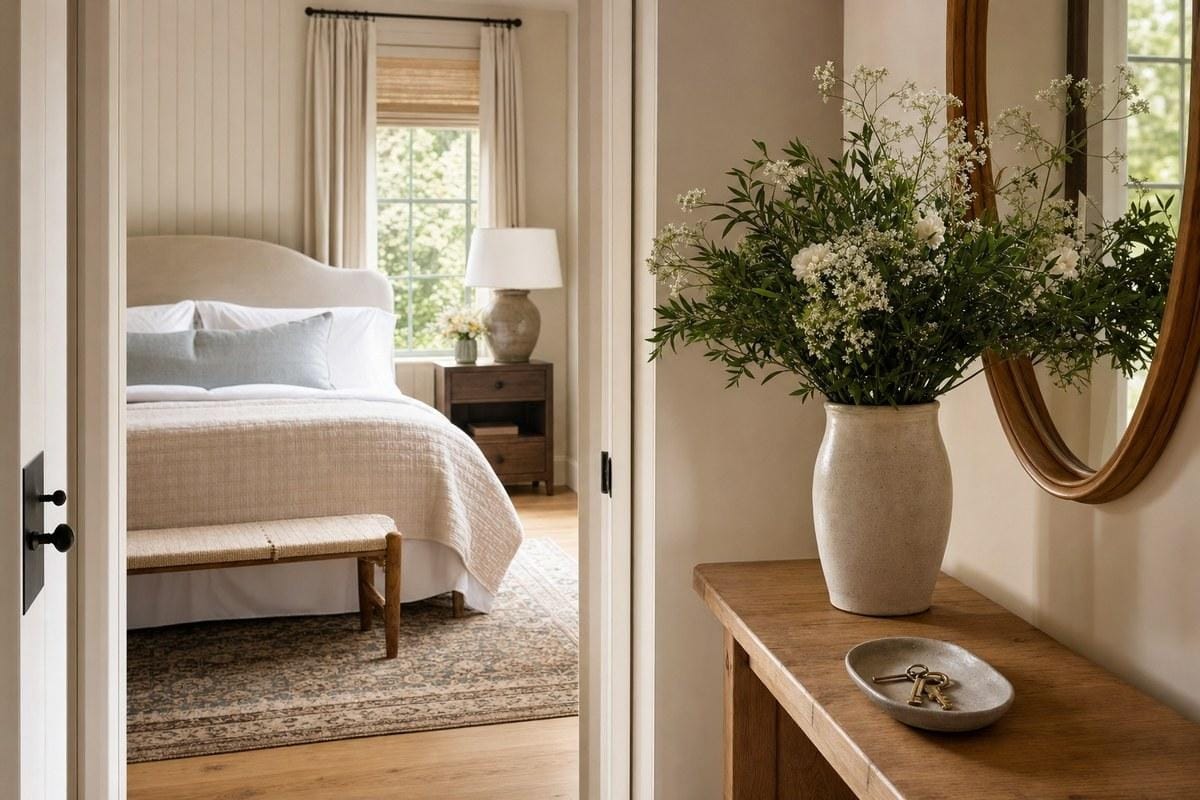
Less than most owners expect. Because your guests are verified homeowners holding their own property to the same standard, you are preparing for peers, not tenants. The work concentrates in three areas: privacy, the house manual, and the staff handoff.
Privacy first. Designate one or two lockable private zones, typically the office and a closet or safe for documents, jewelry, and anything irreplaceable. Most members leave their art on the walls and their books on the shelves; the home should stay itself. For a room-by-room approach, see our guide to securing your home's most valuable assets while traveling. Wine collections follow the same logic: lock the cellar if it matters, and leave a good bottle out with a note, because that bottle is what your guests will remember.
The house manual does the hosting for you. One document covering arrival, alarm and Wi-Fi, house systems, pool and spa, quirks worth knowing, and your favorite table in town. Write it once; it serves every future exchange.
Staff continuity is your quality guarantee. Keep your housekeeper on the usual schedule, introduce your guests to the estate manager or gardener by name, and route the key handoff through the person who knows the home best. If a caretaker runs the property in your absence, our vacation home handoff guide covers the briefing in detail.
Read also: Prepare Your Luxury Home for a Seamless Home Swap
What Happens If Something Goes Wrong on a House Swap?
Rarely much, and never without recourse. Verified exchanges carry structural guarantees: HomeExchange Collection backs every confirmed stay with $3M damage protection, replacement accommodation from $350 up to $500 per night for larger groups if an exchange is cancelled or the home does not match its listing, and a 24/7 member phone line in English, Spanish, and French.
The honest picture is that incidents in a vetted, reviewed home exchange community are uncommon, and the ones that occur are usually logistical: a delayed flight, a misread arrival time, a broken glass. The platform's role is to make the uncommon cases boring, which is what deposits, documentation, and a phone number answered at 3 a.m. accomplish. For a clear-eyed walkthrough of the process, read what happens if a luxury swap goes wrong.
What the guarantees cannot do is replace judgment, which is why the etiquette above matters: members who communicate well before the exchange almost never need the guarantees after it.
House Swap Vacation FAQ
How long does a typical house swap last?
Most house swap vacations run one to two weeks, long enough to settle into a neighborhood rather than tour it. Weekend exchanges are common between nearby members, and established members arrange stays of a month or more, particularly around second homes. Some go as long as one to six months.
Do the homes have to be of equal value?
No. Exchanges are matched on trust and fit, not appraisal. Within Collection, every home has already met the $2M+ verification standard, and GuestPoints absorb any remaining difference: a larger or more sought-after home simply earns more points when hosting. We cover the mechanics in the truth about unequal-value exchanges.
What is the best vacation home exchange site for house swapping?
It depends on the home you are offering and the kind of trip you want to arrange. Platforms like Kindred and HomeLink serve city apartments and mass-market home swaps well. For verified $2M+ homes, HomeExchange Collection is the dedicated tier: every member is vetted, every stay is backed by guarantees, and the network holds 10,000+ luxury homes across the world. Compare membership cost, verification, support, reviews, available locations, and whether the exchange format fits your travel plans. Our comparison of home exchange websites reviews the field.
Can you swap houses if you have pets or plants?
Yes, and it is one of the community's most valued arrangements. HomeExchange offers "pets to feed" and "plants to water" filters, and many guests happily care for a cat, a garden, or a greenhouse as part of the stay. Terms are agreed member to member in advance, so nothing is assumed.
What are the downsides of house swapping?
Lead time and flexibility. Matches take weeks to arrange, the best homes confirm high season months ahead, and members who need exact dates in exact places wait longer. Home swapping rewards planners and the open-minded; it frustrates the last-minute traveler. The first swap also carries setup work that later ones do not.
The First Swap Is the Hardest, and You Only Do It Once
Every experienced member tells the same story: months of deliberation before the first exchange, then the quiet realization, somewhere in week one, that they were living in a place instead of visiting it. A house swap vacation is not a discount strategy. It is the difference between passing through a destination and briefly belonging to it, with your own home cared for by people who understand exactly what it took to build.
The network is waiting on the other side of a verification and a listing. Membership is $1,500 a year, with no nightly rate on any stay, and the first conversation with a fellow owner costs nothing but a well-written note.
Read also: The First-Time Home Swap Blueprint